






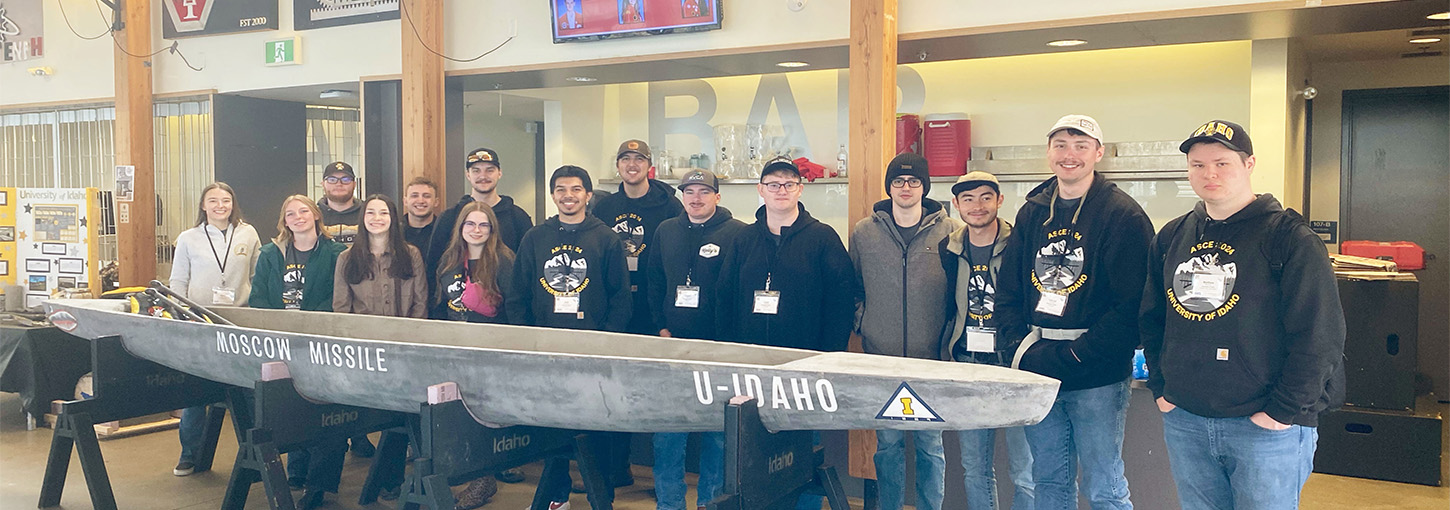

Design sustainable infrastructure that makes life safer for all, enables economic prosperity and creates harmony between natural and built environments.
The University of Idaho Department of Civil and Environmental Engineering offers bachelor’s, master’s and doctoral degrees.
Experience the difference and what it means to engineer like a Vandal.
2024-25 News
Industry Leaders Seek More Vandal Engineers
Because of our strong industry partnerships and the excellent reputation of our students, our department is currently receiving more requests from employers looking to hire than we have students. According to our partners, the job market for civil engineers is HOT right now and should only improve in the coming years with the passage of the new federal infrastructure bill. Contact us for more information, and come join us in beautiful Idaho!
- CEE is hiring 2 new faculty in the areas of Structural Engineering, and Geological Engineering.
- Donations have been secured to start renovating 3 labs: the Ardurra Water Lab, the Structures Lab, and an Advanced Computing Lab.

Fast Facts
- No. 1 Best Value Public University in the West – ranked for the fifth year in a row by U.S. News and World Report. We’re also the only public university in Idaho to be ranked best value by Forbes, Money and The Princeton Review.
- Top 7 in the Nation for “infusing real-world experiences into engineering education” through our undergraduate Senior Capstone Design Program – National Academy of Engineering
- Personalized Attention from nationally and internationally recognized faculty and staff through small class sizes, 1-on-1 interaction, mentorship, advising and research collaboration. All faculty hold Ph.D.s in their field.
- 93% Graduate with Jobs or are enrolled in graduate education or military service – First Destination Survey
- Highest Salary Earnings for early- and mid-career undergraduate degree recipients than any other public university in Idaho – Payscale
- More Scholarships Awarded than any 4-year public engineering college in Idaho. The CEE department awards approximately $150,000 per year in scholarships.
- Hands-On Experience, Guaranteed ALL U of I College of Engineering students participate in hands-on experiences, through our nationally recognized Senior Capstone Design Program and Engineering Design EXPO, Cooperative Education Program (Co-op), Idaho’s only Grand Challenge Scholars Program and paid undergraduate assistantships.
The Bachelor of Science (B.S.) degree program in civil engineering at the University of Idaho is accredited by the Engineering Accreditation Commission of ABET, http://www.abet.org, under the commission’s General Criteria and Program Criteria for Civil and Similarly Named Engineering Programs.